
Subfamily DOLICHODERINAE |
|
 |
 |
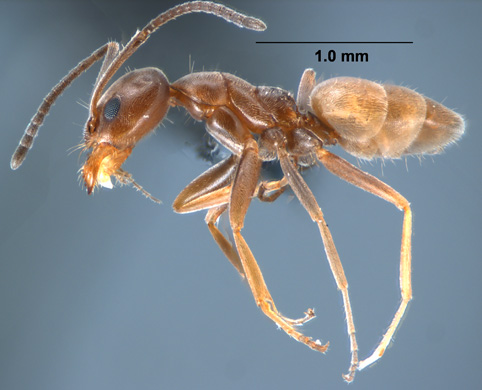
Forelius sp. B., profile view of worker (click image to enlarge). |
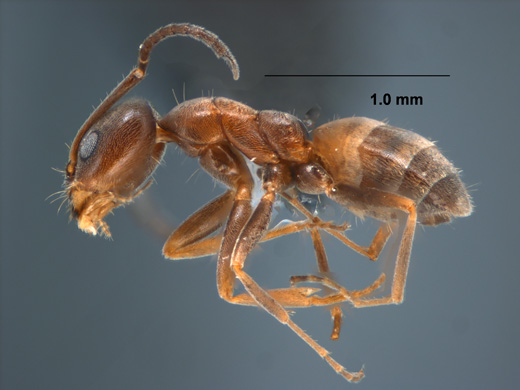
Forelius sp. B., profile view of worker. (click image to enlarge). |
 |
 |
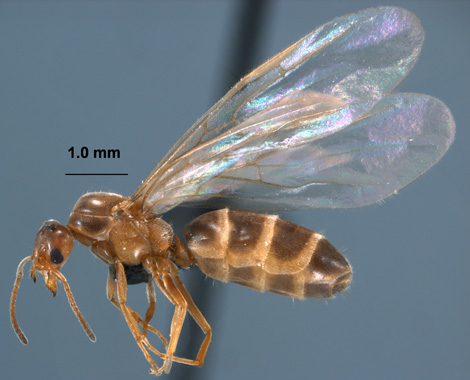
Forelius sp. B., profile view of alate queen (click image to enlarge). |
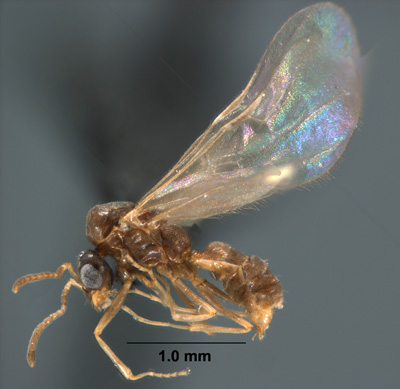
Forelius sp. B. profile view of male (click image to enlarge). |
 |
 |
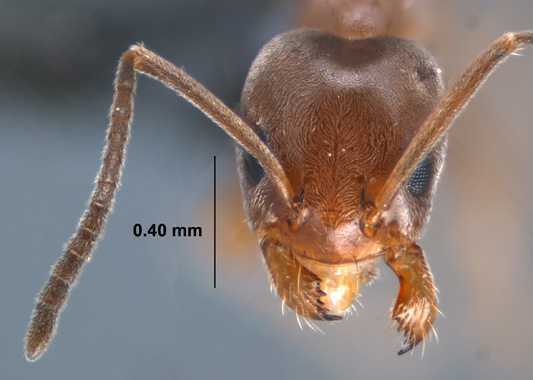
Forelius sp. B., full face view of worker (click image to enlarge). |
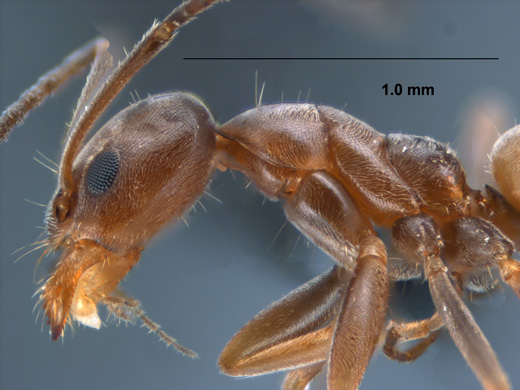
Forelius sp. B. , profile view of worker showing head, alitrunk and petiole. (click image to enlarge). |
Introduction At this time the Forelius situation in the southeastern United States is somewhat confusing, and I am not sure anybody really knows what is going on. Most references mention both F. analis and F. mccooki as being western species; however F. analis has been recorded from the Southeast as well (historic records). At one time in the not so distant past, F. analis was considered a subspecies of F. pruinosus (Bolton 1995). Later, Ward (2005) sunk F. analis into F. pruinosus. This synonymy does not really resolve the problem, because we clearly have two common, distinct species and another undescribed species in the Southeast. The dark ones we find in sandy habitats are clearly F. pruinosus. The other common species in the region was formerly called F. analis and is easily distinguished from F. pruinosus. With the name F. analis not accepted as a valid species name, that created the question of what our other species should be called. It is similar to western F. mccooki, but differs by having less abundant erect setae on the body and scapes. Until we resolve the taxonomy, we are calling this common southeastern morphotype Forelius sp. B. Basically, at this time it looks like there are three species known to occur in the Southeast: F. pruinosus, F. sp. A, and F. sp. B. Forelius pruinosus, strictly a sand inhabiting ant, is apparently a good species, and is dark-gray to black colored with very few erect hairs on the body and none on the scapes and legs. This species appears to be found only in areas of deep sand. Forelius sp. A. appears to be an undescribed sand dune inhabiting species. It is a lighter yellowish gray color and differs from our other two southeastern species in that it is extremely hairy in appearance with erect hairs covering much of the body including the legs and scapes. Forelius sp. B seems to fall somewhere between those two species and has fewer erect hairs on the body than the new species (but more than F. pruinosus) and few to no erect hairs on the scapes. Identification Biology and Economic Importance Distribution Literature Cited Smith, M. R. 1965. House-infesting ants of the Eastern United States, their recognition, biology, and economic importance. United States Department of Agriculture, Technical Bulletin No. 1326: i-105. Ward, P. S. 2005. A synoptic review of the ants of California (Hymenoptera: Formicidae). Zootaxa 936: 1-68. Links |
|


MEM | Research Taxa | Introduction | Faunal Lists | Identification | How to Use the Keys | Glossary | Collecting Tips | Specimen Preparation MEM Publications | MEM Ant Publications | Ant Videos | Ant News | MEM Ant Blog | References | Acknowledgments | Links
Author-Joe MacGown: jmacgown@entomology.msstate.edu
The ant web site was uploaded on 6 March 2003 and was last updated on 11 September 2024
(specific pages may have different uploaded and updated dates)
Drawings and photographs by Joe MacGown (unless otherwise noted) and copyrighted by the Mississippi Entomological Museum
The development of this web site was supported in part by the National Institute of Food and Agriculture, United States Department of Agriculture, under Project No. MIS-012040 and the USDA-ARS Areawide Management of Imported Fire Ant Project (Richard L. Brown, Principal Investigator).