Blacklight Traps and Light Trapping
Author: Joe A. MacGown (1) and Pat Wooden (2)
(1) Mississippi Entomological Museum, Mississippi State University, MS 39762
(2) Virginia Tech Insect ID Lab, Blacksburg VA 24061
Uploaded March 16, 2026
|
Blacklight traps include a variety of trap types, but what they all have in common is the "blacklight" or ultraviolet light (uv). We use 15 watt uv lights for our blacklighting endeavors. The blacklight is used for collecting many insects that are active and flying at night and are attracted to uv light. This includes many moths, as well as a whole bunch of other insects. The lights can either be placed in a metal vane (see bottom photo) above a collecting container with a killing agent, or they can be hung downward from the top of a white sheet, which they illuminate. The lights are powered by a lawn mower battery, car battery, or a generator. In addition to uv light, other more powerful lights such as mercury vapor lights, may be hung from ropes to illuminate the sheet.
When using a uv light with a sheet, the insects are selected from the sheet by the collector. So really, it isn't a trap at all, although we often refer to it as one. Setting up a sheet is quite simple, especially if some trees are present. In the case of two trees, a rope is tied between the trees, being looped around twice, so that the sheet can be hung from one sheet, and the uv light from the other. If no trees are available, then a free standing trap must be used. These can be made from lightweight metal piping or PVC water piping. However, when using the rope method, the sheets can be hung with strong safety pins or other means. Generally, the top of the sheet should not be higher than one can reach. Leftover sheet can be folded over on the ground so that a shelf of about 1 ft is left. More than this will make it hard to step around the sheet without stepping on those insects that fall to the fold. For aquatic collecting, having this shelf is crucial, as many insects, like water boatmen, are not able to hold onto the vertical sheet and will be lost if not collected from the ground. At the point where the sheet is folded, it is usually staked on each side to the ground. The light is always on the side of the sheet with the fold and should be facing the direction you most want to draw the insects from. Insects are collected with killing jars as they are sighted.
|
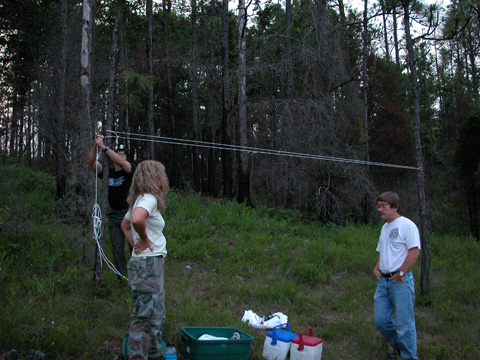
Tying the rope between two trees (photo by Joe A. MacGown)
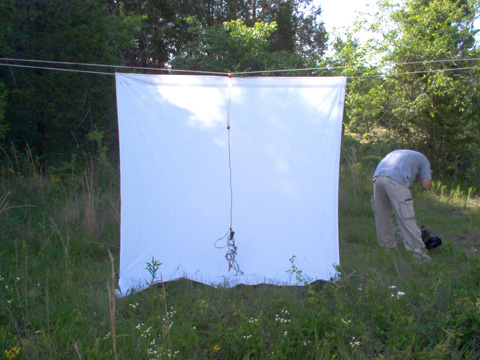
The sheet and light are hung (photo by MEM staff)
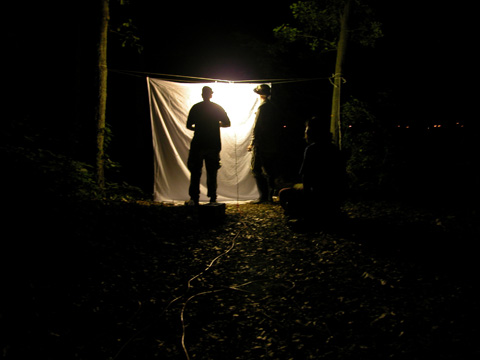
Collecting insects off of sheet with UV light at night (photo by Joe A. MacGown)
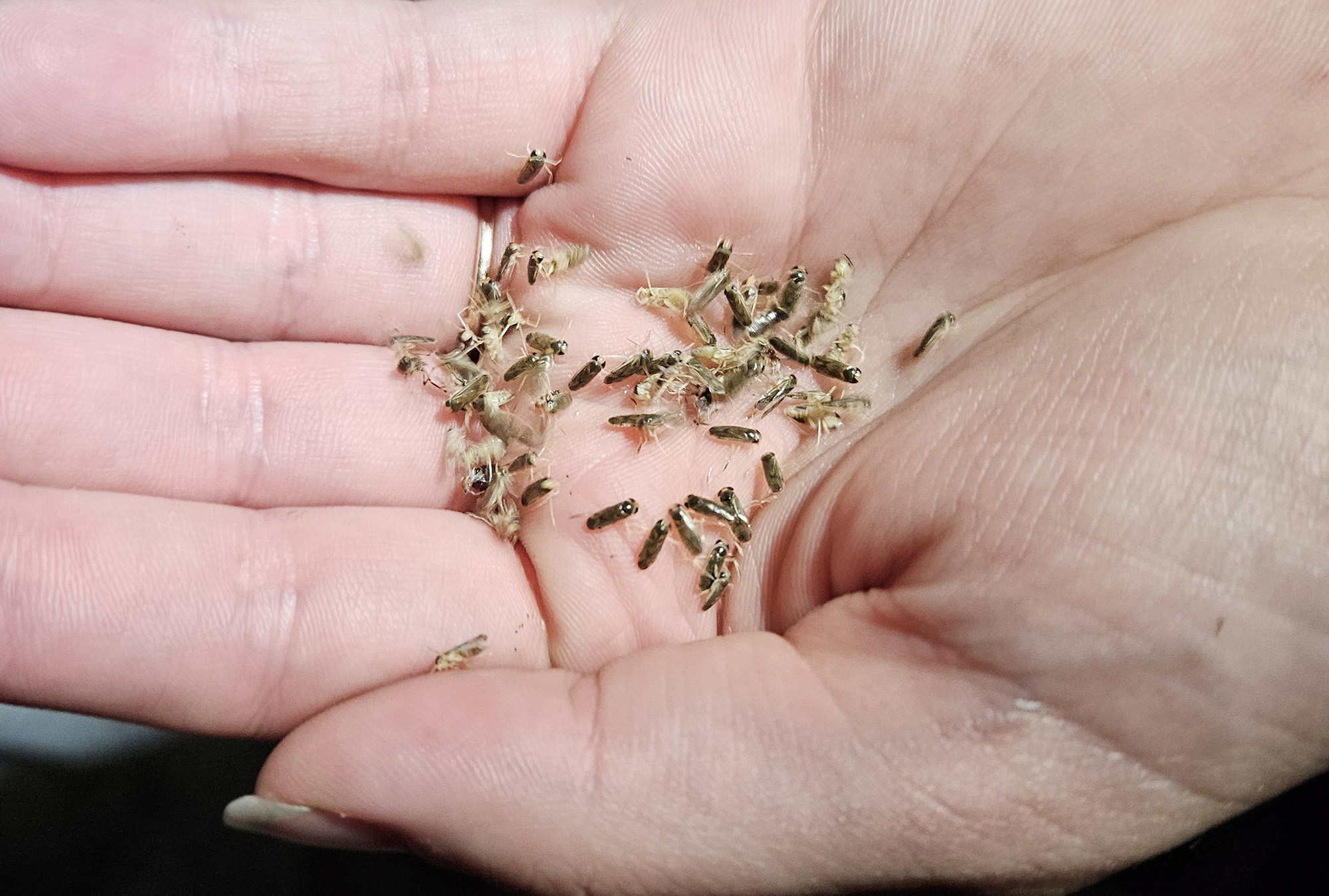
Corixidae (Water Boatmen) collected at a blacklight sheet (photo by P. Wooden)
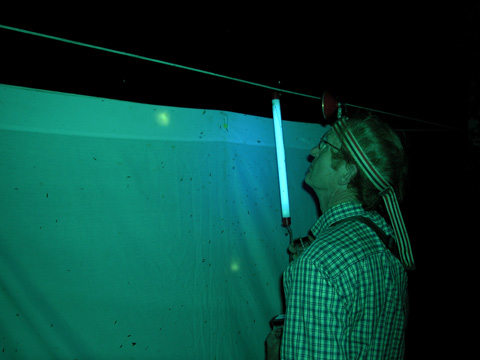
Richard Brown, perusing the sheet for small moths (Joe A. MacGown)
|
When blacklights are used in conjunction with a container for collecting, they are being used as an actual trap. This type of "boxtrap" or “bucket trap” is usually placed in the desired collecting habitat just before dark and retrieved the following morning. A car battery or lawnmower battery will power traditional lights, but we have had success with LEDs powered by jackeries and power banks. The container that the insects fly into can be variable in size and must have some type of killing agent in them. For people collecting beetles, they can partially fill the container with ethanol. But for moth collectors, a dry killing agent must be used. Ethyl acetate works well, as does various types of cyanide. However, cyanide is very poisonous, and should not be used without the proper precautions. In these dry traps, moths can become badly damaged by just a few bad beetles. To remedy this problem, we use 3 or so different sized screen mesh partitions within the container, with the biggest mesh screen on the top and the smallest on the bottom. The large insects cannot make their way to the bottom, whereas the small moths go through the mesh to the smaller screens, or even to the bottom where they fall into one of two small partitioned containers (egg cartons for dove eggs). Boxtraps are usually placed in open areas where they can draw insects in from far away. A good night catch in one trap may have several thousand moths in it with several hundred species. |
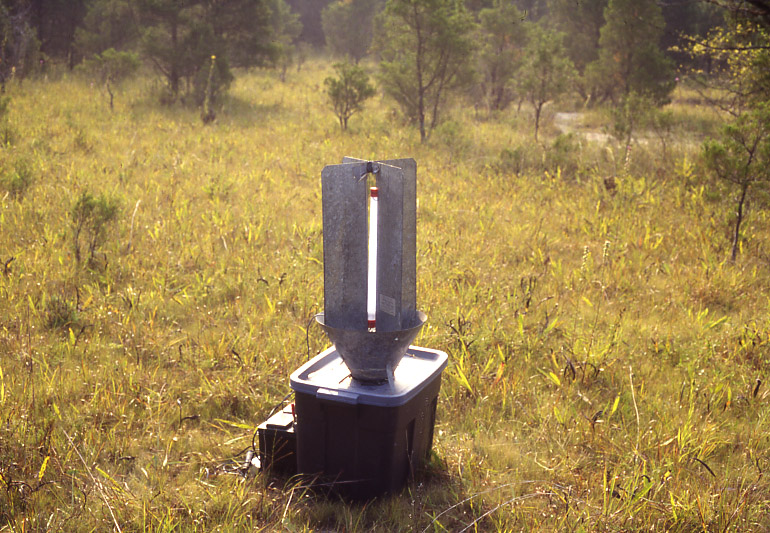
A "boxtrap" placed in an open glade (photo by Joe A. MacGown)
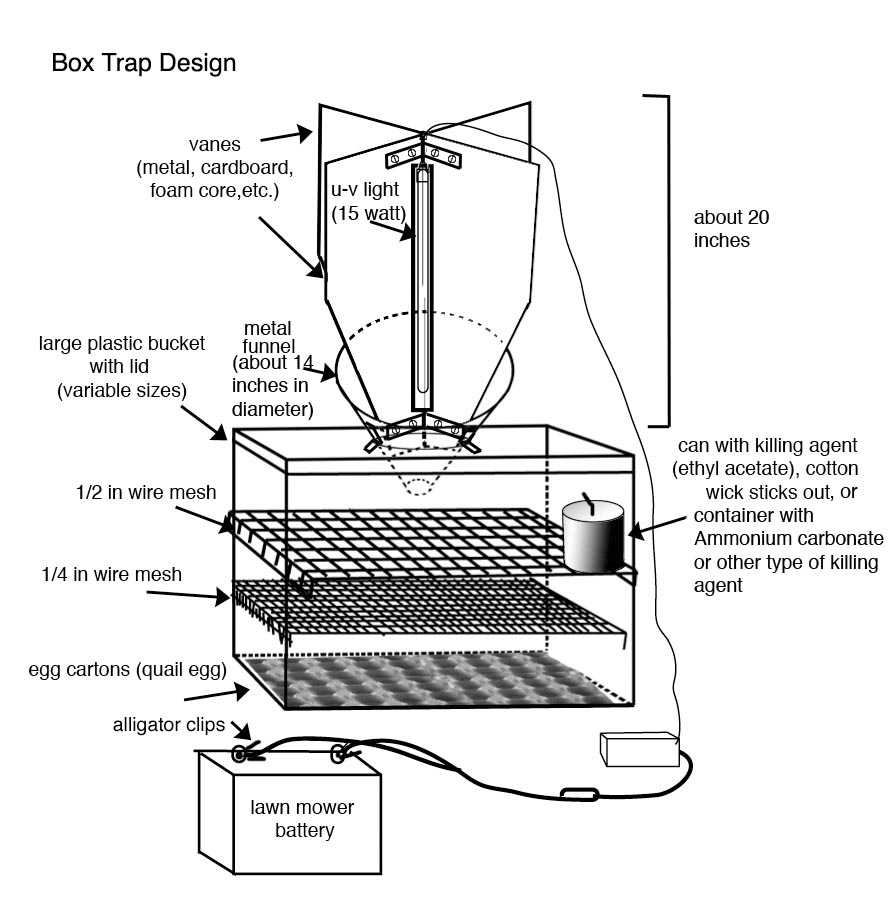
Diagram of a Boxtrap (drawing by Joe A. MacGown)
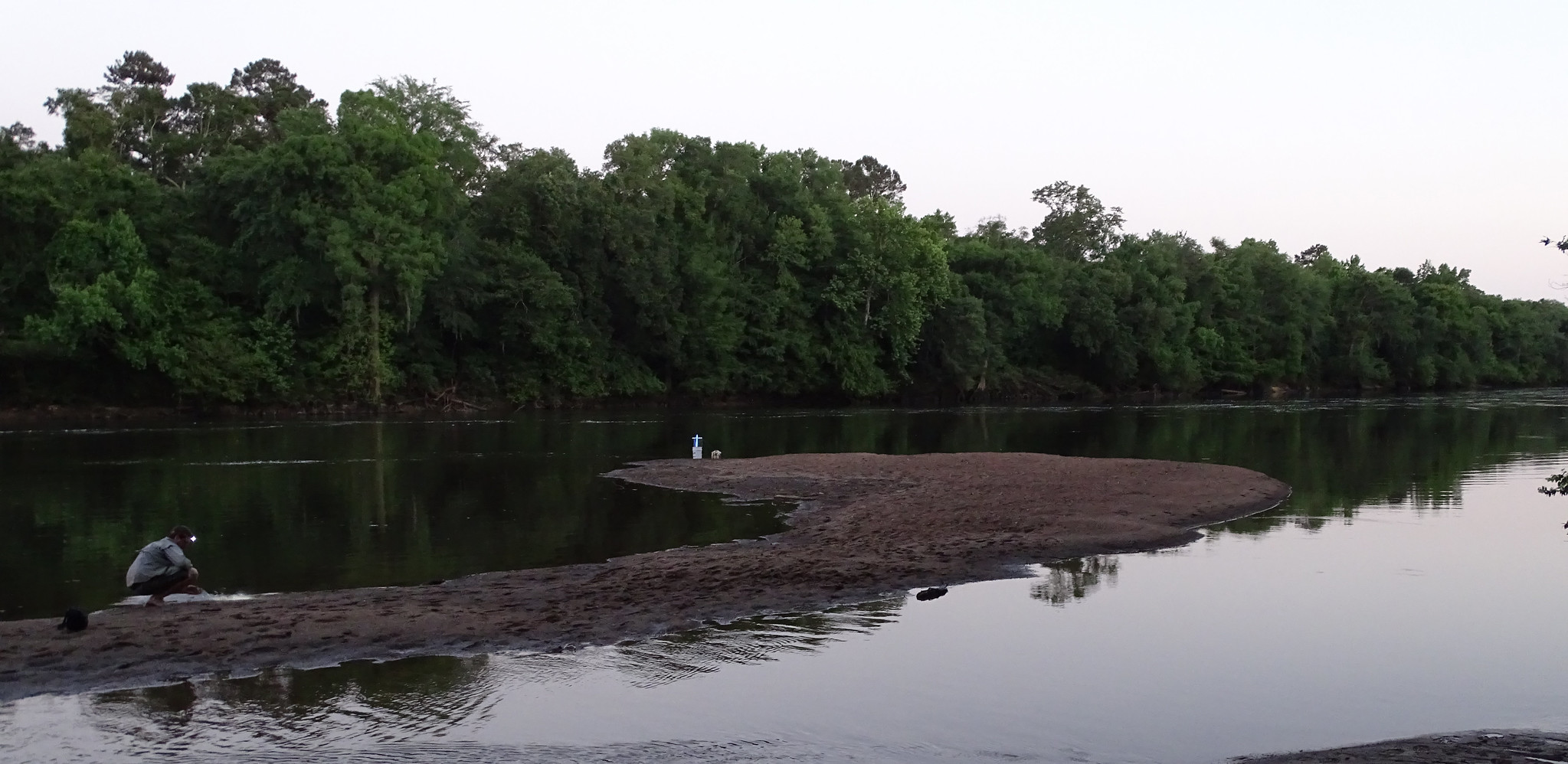
Bucket Trap on sandbar and in wetland (photo by Mike Ferro, CUAC)
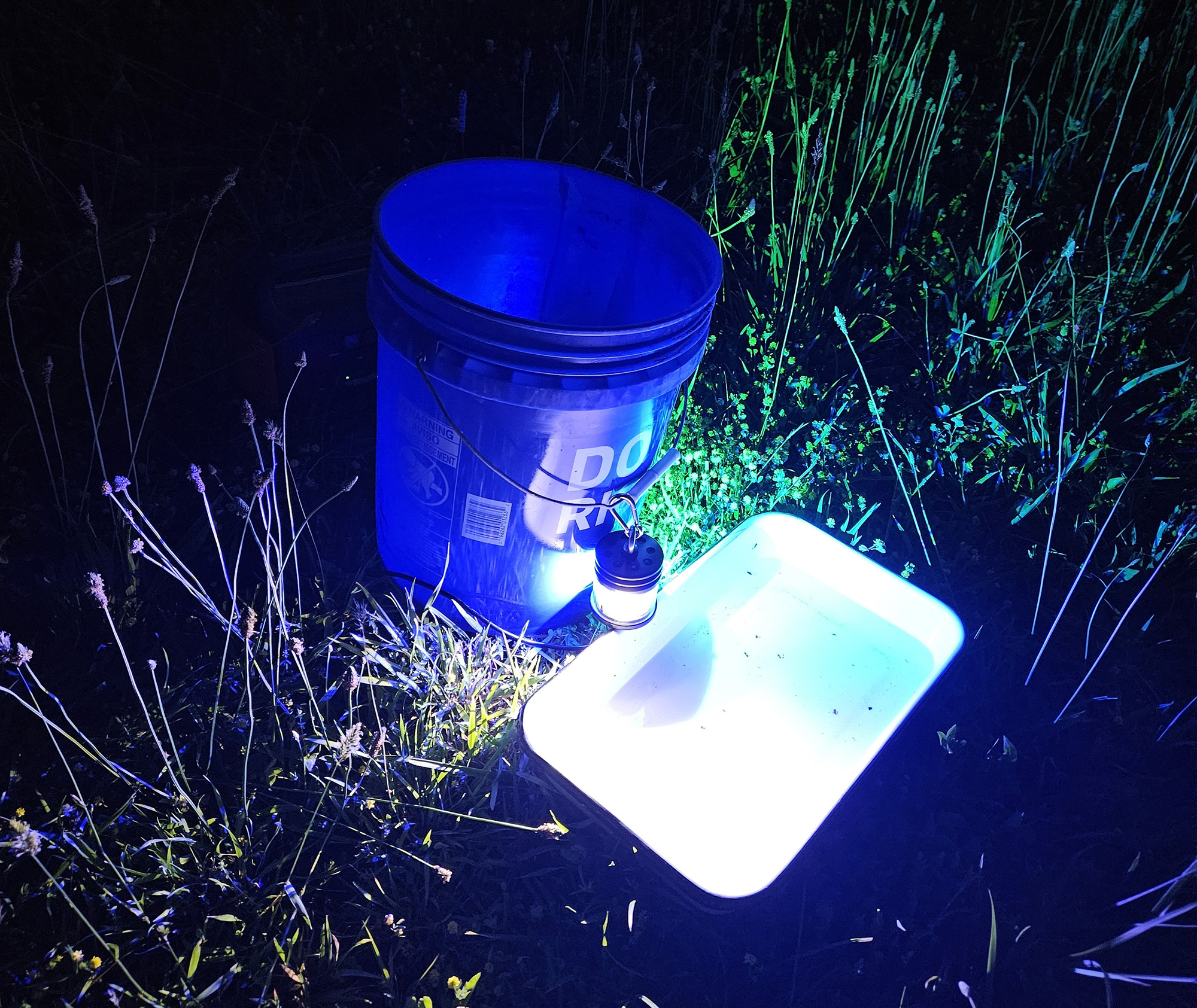
Pan blacklight trap setup (Photo by P. Wooden)
|
For aerial aquatic collecting, a bucket, or shallow white pan with a blacklight suspended just above it, can be partially filled with ethanol and placed in or next to an aquatic habitat. Bridge crossings, sandbars, and hillsides are excellent localities because the insects can see them from far away. This is a great way to catch flying aquatic insects including caddisflies, true bugs, etc. |
 Pat Wooden holding quatrefoil light trap
|
Quatrefoil light traps can also be set in ponds and wetlands to draw in swimming aquatic insects. These light traps were originally designed for larval fish, and can be purchased from fish research websites or created with plexiglass and foam insulation. Insects are drawn to the light (and the larval fish!) and then get stuck in the foiled design. When the trap is raised out of the water, all the specimens are forced down through the bottom of the trap. It’s important to affix a bag or cup to the bottom of the trap so that samples can be collected and to secure these floating traps to a tree or dock so they aren’t lost.
|
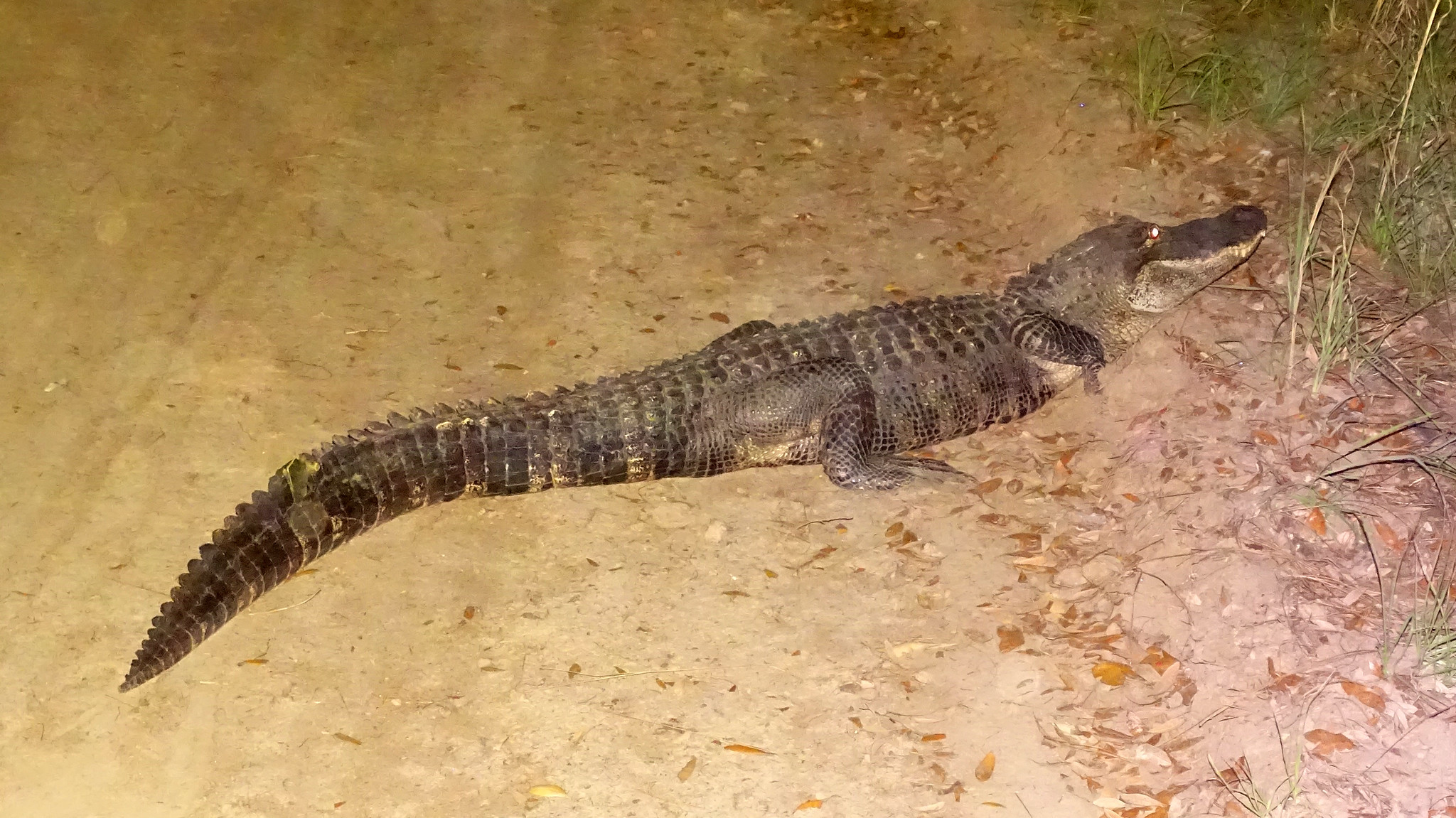
Alligator at blacklight set-up (Photo by Mike Ferro, CUAC)
|